
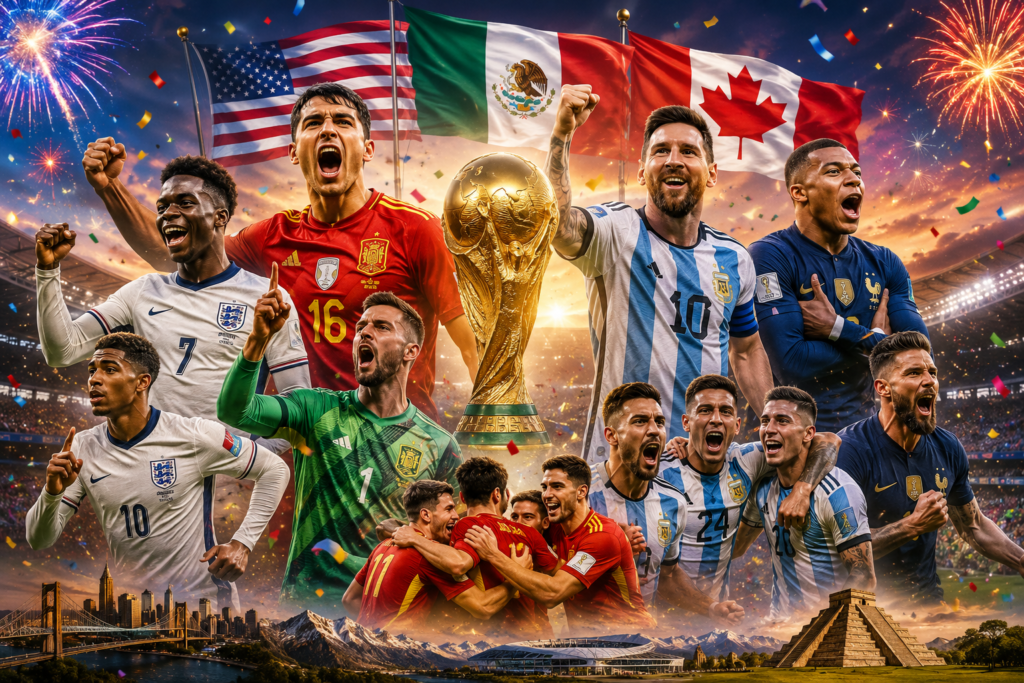
Did the biggest FIFA World Cup in history deliver everything football fans had hoped for? The FIFA World Cup 2026 answered that question with unforgettable matches, dramatic upsets, and outstanding individual performances. Hosted by the United States, Canada, and Mexico, this tournament introduced the new 48-team format and became the largest World Cup ever organized. Spain lifted the trophy after defeating Argentina in a tense final, while several emerging nations proved they could compete with football’s traditional powers. From record-breaking attendance to unforgettable goals, the tournament created memories that will remain part of football history for years to come.
FIFA World Cup 2026 at a Glance
The 2026 FIFA World Cup featured 48 national teams competing across three host countries. A total of 104 matches were played during six weeks, making it the longest World Cup in history. Fans witnessed more than 300 goals along with numerous thrilling knockout matches. The expanded tournament gave several nations their first opportunity to compete on football’s biggest stage, making the competition more diverse than ever before.
Host Countries and Stadiums
For the first time, three countries jointly hosted the FIFA World Cup. The United States welcomed most of the matches, while Canada and Mexico also played important roles throughout the tournament. Modern stadiums, excellent transportation, and enthusiastic supporters created an incredible atmosphere from the opening match to the final. Millions of fans traveled across North America, making every venue vibrant and memorable.
New 48-Team Format
The biggest change in FIFA World Cup 2026 was the expansion from 32 to 48 teams. Twelve groups competed before the tournament moved into an expanded Round of 32, giving fans more knockout football than ever before. Although some experts initially questioned the new structure, the format produced exciting matches and several surprise results. Smaller football nations benefited from greater opportunities to compete against elite teams.
Spain’s Road to the Championship
Spain started the tournament with an unexpected draw but quickly found their best form. They defeated every major opponent through disciplined defending, intelligent passing, and clinical finishing. Victories over Portugal, Belgium, and France secured a place in the final against Argentina. Ferran Torres scored the winning goal in extra time, helping Spain win their second FIFA World Cup title.
Argentina’s Impressive Campaign
Argentina entered the competition as defending champions and once again reached the World Cup final. Lionel Messi inspired his teammates with experience, creativity, and leadership throughout the tournament. Argentina defeated several strong opponents before facing Spain in the championship match. Despite an excellent performance, they narrowly missed defending their title after losing 1-0 in extra time.
England’s Best Performance Since 1966
England enjoyed one of their finest World Cup campaigns in decades under Thomas Tuchel. The team played confident attacking football and reached the semi-finals after several dramatic knockout victories. Although Argentina stopped their journey to the final, England responded brilliantly by defeating France 6-4 in the third-place match. Bukayo Saka and Jude Bellingham emerged as two of the tournament’s brightest stars.
France’s Strong Attack and Defensive Problems
France entered the tournament as one of the favorites thanks to their world-class squad. Kylian Mbappé led the attack with remarkable consistency and eventually won the Golden Boot. However, defensive mistakes in the final stages prevented France from reaching another World Cup final. Their fourth-place finish was respectable, but many fans expected even more from such a talented team.
Surprise Teams That Won Hearts
Several underdog nations became the biggest stories of the tournament. Cabo Verde shocked football fans by reaching the knockout stage and earning valuable results against stronger opponents. Morocco once again demonstrated their growing strength by advancing deep into the competition. Switzerland and Colombia also impressed with disciplined performances and fearless football against elite nations.
Biggest Disappointments
Not every football giant enjoyed success in North America. Uruguay failed to escape the group stage despite entering the tournament with high expectations. Portugal saw Cristiano Ronaldo’s World Cup career come to an emotional end after an early knockout defeat. Germany also struggled to meet expectations, proving that reputation alone is never enough to succeed at the World Cup.
Best Players of FIFA World Cup 2026
Several players delivered unforgettable performances throughout the tournament. Rodri controlled Spain’s midfield and played a major role in their championship-winning campaign. Kylian Mbappé finished as the tournament’s top scorer, while Lionel Messi once again demonstrated his exceptional quality despite his age. Goalkeeper Unai Simón also produced outstanding performances with multiple clean sheets.
Top Goal Scorers
Goals remained one of the biggest attractions throughout the competition. Kylian Mbappé finished as the leading scorer with ten goals and claimed another Golden Boot. Lionel Messi, Ferran Torres, Jude Bellingham, and Erling Haaland also enjoyed productive tournaments. Their performances produced some of the most exciting moments of the competition.
Records Broken During the Tournament
The FIFA World Cup 2026 set numerous new records both on and off the field. It became the first tournament to feature 48 teams and 104 matches. Attendance reached historic levels as millions of supporters filled stadiums across North America. Spain’s defensive record, Messi’s appearance milestone, and Mbappé’s scoring achievements added further significance to this memorable tournament.
Memorable Matches
Many matches will be remembered long after the tournament ended. Spain’s extra-time victory over Argentina in the final delivered an emotional conclusion to six weeks of football. England’s thrilling 6-4 win against France became one of the highest-scoring matches in World Cup history. Several penalty shootouts and dramatic comeback victories also kept supporters on the edge of their seats.
Tournament Statistics
The competition produced 308 goals across 104 matches, averaging nearly three goals per game. More than six million supporters attended matches in the three host countries. Goalkeepers delivered outstanding performances despite the high number of goals scored. The tournament also featured numerous clean sheets, late winners, and exciting extra-time encounters.
Lessons from FIFA World Cup 2026
The expanded World Cup proved that international football is becoming more competitive every year. Emerging nations showed they can challenge traditional football powers with disciplined tactics and fearless performances. Squad depth became more important because of the longer tournament schedule. Overall, FIFA World Cup 2026 demonstrated that expanding the competition has strengthened global football rather than weakening it.
Conclusion
The FIFA World Cup 2026 will be remembered as one of the greatest tournaments in football history. Spain deservedly became world champions after displaying consistency, discipline, and outstanding teamwork throughout the competition. Argentina, England, and France also produced memorable campaigns, while several underdog nations inspired football fans around the world. With record-breaking attendance, unforgettable matches, and the successful introduction of the 48-team format, the tournament established a new benchmark for future FIFA World Cups.
Frequently Asked Questions
1. Who won the FIFA World Cup 2026?
Spain won the tournament after defeating Argentina 1-0 after extra time in the final.
2. Which countries hosted FIFA World Cup 2026?
The tournament was jointly hosted by the United States, Canada, and Mexico.
3. How many teams participated?
A record 48 national teams competed in the 2026 FIFA World Cup.
4. Who finished as runners-up?
Argentina finished second after losing the final to Spain.
5. Who won the Golden Boot?
France’s Kylian Mbappé won the Golden Boot with ten goals.
6. Which team finished third?
England secured third place by defeating France in the bronze medal match.
7. How many matches were played?
A total of 104 matches were played during the tournament.
8. How many goals were scored?
The tournament produced 308 goals across all matches.
9. What made FIFA World Cup 2026 historic?
It was the first World Cup featuring 48 teams and the first hosted by three countries.
10. Why was Spain successful?
Spain combined excellent defending, midfield control, tactical discipline, and consistent performances throughout the tournament to claim their second World Cup title.