introduction
The Kukri Blue Gem is one of the most exciting and highly discussed knife skin variations in Counter-Strike 2. Ever since the Kukri Knife was introduced, collectors and traders have searched for rare Case Hardened patterns that display an exceptional amount of blue. These unique patterns are commonly known as “Blue Gems” and are among the most valuable cosmetic items in the game.
Unlike standard skins, every Case Hardened skin has a randomly generated pattern. This means no two knives look exactly the same. Some patterns feature mostly gold or silver coloring, while a very small percentage display a dominant blue finish. Because of their rarity, Blue Gems have become status symbols among collectors and investors.
In this guide, you will learn what makes a Kukri Blue Gem special, how the pattern system works, how to identify valuable patterns, factors affecting price, buying tips, trading advice, and answers to frequently asked questions.
What Is a Kukri Blue Gem?
A Kukri Blue Gem is a Kukri Knife with the Case Hardened finish that features an unusually high percentage of blue on its blade. The term “Blue Gem” is a community-created name rather than an official classification.
Most Case Hardened knives contain a mix of:
- Blue
- Gold
- Purple
- Silver
Only a small number of pattern seeds generate a blade with large blue coverage. These rare patterns attract collectors because they are visually unique and significantly harder to obtain than ordinary Case Hardened knives.
Understanding the Case Hardened Pattern System
Every Case Hardened skin receives a pattern seed when it is created. This pattern seed determines how the colors appear on the weapon.
Although the finish remains the same, the placement of blue, gold, and silver differs from one knife to another.
Some patterns may show:
- Mostly gold
- Half blue and half gold
- Blue only near the tip
- Blue across the entire play side
- Blue mainly on the back side
Since every seed is different, rarity depends on the amount and placement of blue.
What Makes a Blue Gem Valuable?
Not every blue-colored Kukri Knife qualifies as a Blue Gem. Collectors look for several important characteristics.
High Blue Coverage
The most valuable knives feature a blade that is almost completely blue. The larger the blue area, the more desirable the knife becomes.
Play Side Appearance
Most buyers value the play side more because it is visible while using the knife during gameplay. A knife with excellent blue coverage on the play side often commands a higher price.
Back Side Quality
Although less important than the play side, some collectors prefer knives that also display significant blue on the reverse side.
Clean Pattern
Patterns with fewer gold patches and uninterrupted blue surfaces are generally considered superior.
Float Value
Float determines the skin’s wear condition.
Lower float values usually result in a cleaner appearance.
Common wear categories include:
- Factory New
- Minimal Wear
- Field-Tested
- Well-Worn
- Battle-Scarred
While Blue Gem rarity is primarily determined by pattern, lower wear can further increase desirability.
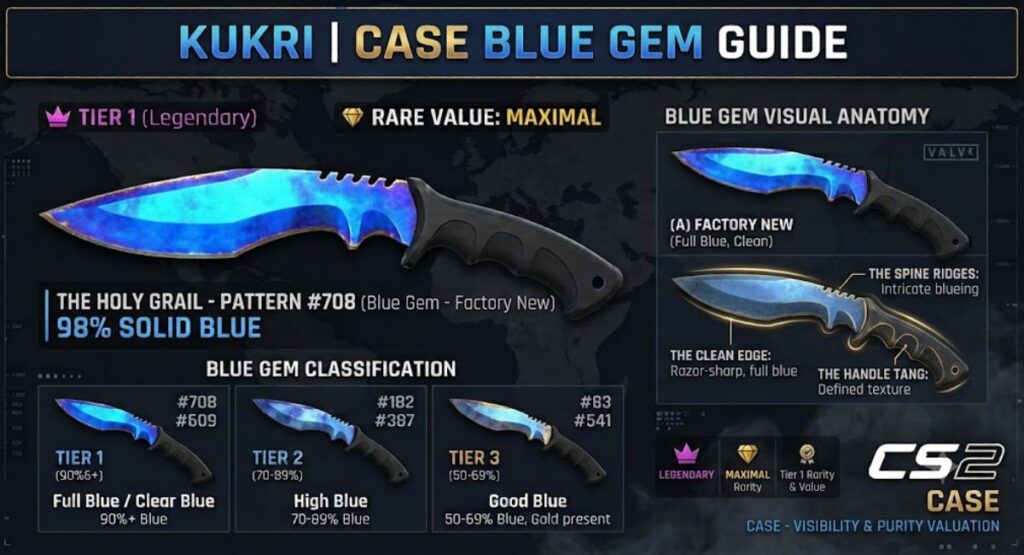
Blue Gem Tier Classification
The community generally divides Blue Gems into several tiers based on blue coverage.
| Tier | Blue Coverage | Collector Demand | Typical Value |
|---|---|---|---|
| Tier 1 | Nearly full blue blade | Extremely High | Highest |
| Tier 2 | Large blue coverage with minor gold | Very High | Very Expensive |
| Tier 3 | Moderate blue coverage | High | Premium |
| Tier 4 | Noticeable blue sections | Medium | Above Standard |
| Regular Case Hardened | Mostly gold or mixed colors | Normal | Standard Market Price |
Different trading communities may classify patterns slightly differently, but the overall concept remains consistent.
Why Are Kukri Blue Gems So Rare?
The rarity comes from multiple factors.
First, only the Case Hardened finish can produce Blue Gems.
Second, only a tiny percentage of pattern seeds generate large blue coverage.
Third, not every Kukri Knife unboxed will have a desirable float.
Finally, collector demand continues to increase while the number of exceptional patterns remains limited.
These factors combine to create an extremely scarce collectible.
How to Identify a Kukri Blue Gem
Before purchasing a knife, inspect it carefully.
Look at the following details:
- Overall blue coverage
- Play side appearance
- Back side appearance
- Float value
- Pattern seed
- Market demand
- Recent trading history
Many experienced traders compare the knife with known Blue Gem databases before making a purchase.
Best Features of High-End Blue Gems
Premium Blue Gems often include:
- Nearly full blue blade
- Minimal gold coloring
- Attractive color balance
- Low float
- Strong collector interest
- Rare pattern seed
- Excellent visual appeal
These characteristics can significantly increase the knife’s value.
How Pattern Seeds Affect Prices
Two Kukri Case Hardened knives with identical wear conditions can have dramatically different prices simply because of their pattern seeds.
For example:
A Factory New knife with average blue coverage may sell for much less than a Field-Tested knife featuring an elite Blue Gem pattern.
Collectors prioritize rarity over wear in many cases.
Is Float More Important Than Pattern?
Generally, no.
Pattern rarity usually has a greater impact on value than float.
For example:
A Tier 1 Blue Gem in Field-Tested condition may be worth considerably more than a Factory New knife with an average Case Hardened pattern.
However, when comparing two identical Blue Gem patterns, the lower float typically commands the higher price.
Buying Tips
Buying a Kukri Blue Gem requires patience and research.
Consider these recommendations:
Study known Blue Gem patterns before purchasing.
Compare multiple listings rather than buying the first available option.
Always inspect screenshots from both sides of the knife.
Verify the pattern seed.
Review previous sale prices.
Purchase from trusted marketplaces.
Avoid overpaying for ordinary Case Hardened patterns marketed as Blue Gems.
Trading Tips
Trading rare knives differs from trading standard skins.
Useful practices include:
Know the exact pattern tier.
Understand current collector demand.
Avoid rushing trades.
Request high-quality screenshots.
Check float values carefully.
Keep records of previous offers.
Be cautious of misleading listings.
Investment Potential
Many collectors view Blue Gems as long-term collectibles rather than ordinary cosmetic skins.
Several factors contribute to their investment appeal:
Limited supply
Growing player base
Strong collector interest
Unique appearance
Historical appreciation of rare Case Hardened patterns
However, prices can rise or fall depending on market conditions, game updates, and community demand. Buyers should never assume guaranteed profits.
Common Mistakes Buyers Make
Many new collectors make avoidable mistakes.
Some of the most common include:
Buying based only on the skin’s name.
Ignoring the pattern seed.
Paying Blue Gem prices for average patterns.
Overlooking the play side.
Ignoring float values.
Not comparing market listings.
Failing to research community pricing.
Avoiding these mistakes can save a significant amount of money.
Why Collectors Love Blue Gems
Blue Gems are more than cosmetic items.
They represent rarity, prestige, and uniqueness.
Unlike many skins that look identical, every Case Hardened knife tells a different story through its pattern. Owning an exceptional Blue Gem allows collectors to possess something that only a handful of players may ever own.
This exclusivity has made Blue Gems some of the most sought-after items in the Counter-Strike skin economy.
Future Outlook
As the Kukri Knife continues to gain popularity, collector interest in Blue Gems is expected to remain strong. New players regularly enter the market, increasing demand for rare cosmetic items.
Although no one can predict future prices with certainty, rare Case Hardened patterns have historically maintained strong collector appeal.
If supply remains limited while demand continues to grow, exceptional Blue Gems are likely to remain highly desirable among traders and collectors.
Conclusion
The Kukri Blue Gem stands among the rarest and most visually impressive knife skins in Counter-Strike 2. Its value comes from an extraordinary combination of pattern rarity, blue coverage, float value, and collector demand. Understanding how pattern seeds work is essential before buying, selling, or trading one of these knives.
Whether you are a new collector searching for your first Blue Gem or an experienced trader looking for a premium investment, careful research and patience are the keys to making informed decisions. By learning to recognize valuable patterns and avoiding common mistakes, you can navigate the market with greater confidence and appreciation for one of the game’s most iconic collectibles.
FAQs
Q1. What is a Kukri Blue Gem?
Answer: A Kukri Blue Gem is a Case Hardened Kukri Knife that features an exceptionally high amount of blue coloring due to a rare pattern seed.
Q2. Why are Kukri Blue Gems so expensive?
Answer: They are expensive because only a small number of Case Hardened patterns produce extensive blue coverage, making them highly sought after by collectors.
Q3. Does the pattern seed affect the knife’s value?
Answer: Yes. The pattern seed is one of the most important factors determining rarity and price.
Q4. Is Factory New always worth more than Field-Tested?
Answer: Not necessarily. A rare Blue Gem pattern in Field-Tested condition can be worth much more than a Factory New knife with a common pattern.
Q5. How can I verify if a Kukri Knife is a real Blue Gem?
Answer: Check the pattern seed, inspect the amount of blue on the blade, compare it with known Blue Gem patterns, and review recent market sales before purchasing.
Q6. Are Kukri Blue Gems good for long-term collecting?
Answer: Many collectors consider them valuable collectibles because of their rarity and strong demand, but future prices are never guaranteed.
Q7. Can two Kukri Case Hardened knives look different?
Answer: Yes. Every Case Hardened knife receives a unique pattern seed, so the color distribution varies from one knife to another.
Q8. What should I check before buying a Kukri Blue Gem?
Answer: Examine the pattern seed, blue coverage, play-side appearance, back-side appearance, float value, seller reputation, and recent comparable sales before making a purchase.