
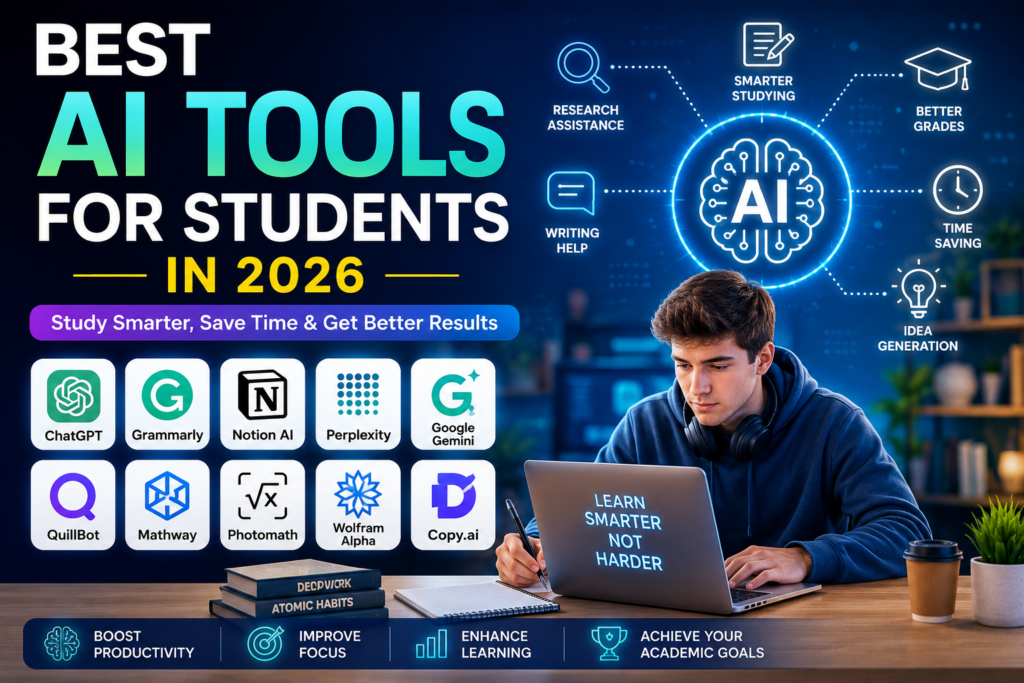
Have you ever wished you could finish assignments faster, understand difficult subjects more easily, and still have enough time for your personal life? Modern artificial intelligence is changing the way students learn, making education more interactive, efficient, and personalized than ever before. Whether you’re preparing for exams, writing essays, organizing notes, or solving complex problems, AI-powered applications can become valuable study companions.
The Best AI tools for students are designed to simplify everyday academic tasks while encouraging smarter learning habits. Instead of spending hours searching for information or rewriting assignments, students can focus on understanding concepts, practicing skills, and improving overall performance. The right tools don’t replace learning—they enhance it by providing instant explanations, personalized recommendations, and better organization.
This guide explores the most useful AI tools available today, explaining their features, benefits, and how they can help students become more productive without compromising academic integrity.
Why AI Is Transforming Student Learning
Artificial intelligence has become an essential part of modern education because it offers personalized support that traditional learning methods often cannot provide. AI analyzes learning patterns, identifies weak areas, and recommends resources based on individual needs. This makes studying more efficient while reducing unnecessary effort.
Students can receive instant explanations, summarize lengthy articles, translate languages, and generate study materials within seconds. Rather than replacing teachers, AI acts as an additional learning assistant available at any time. As educational technology continues to evolve, AI is becoming a practical tool for learners at every academic level.
How to Choose the Right AI Study Tool
Not every AI application is suitable for every student. Some tools specialize in writing assistance, while others focus on mathematics, programming, research, or language learning. Choosing software based on your academic requirements ensures you receive maximum value.
Ease of use, accuracy, privacy, and affordability are equally important factors. Free versions are often sufficient for everyday academic work, while premium subscriptions offer advanced capabilities for students with demanding coursework. Comparing features before selecting a platform helps avoid unnecessary expenses.
ChatGPT for Learning and Research
ChatGPT has become one of the most versatile educational assistants available today. It explains complex concepts in simple language, creates summaries, generates practice questions, and helps students brainstorm ideas for projects and presentations. Many learners also use it to improve grammar, coding skills, and interview preparation.
Instead of copying generated answers directly, students should use ChatGPT as a learning partner that explains topics and encourages deeper understanding. This approach improves critical thinking while maintaining academic honesty. Used responsibly, it supports independent learning across almost every subject.
Grammarly Makes Writing More Professional
Writing assignments require clarity, proper grammar, and logical structure. Grammarly uses artificial intelligence to identify grammar mistakes, punctuation errors, awkward sentences, and unclear wording. It also provides suggestions that improve readability and writing confidence.
Students working on essays, research papers, scholarship applications, or emails benefit from real-time corrections while learning from their mistakes. Over time, these improvements help develop stronger communication skills that remain valuable beyond academic life. Better writing also creates a more professional impression.
Notion AI for Better Organization
Managing multiple subjects, deadlines, and notes can become overwhelming without proper organization. Notion AI helps students create structured notes, summarize meeting discussions, organize projects, and generate study plans automatically. Everything remains stored in one searchable workspace.
Its flexibility allows users to build personalized dashboards for assignments, revision schedules, and class materials. Students no longer need separate applications for note-taking and task management. Better organization leads to improved productivity and reduced stress throughout the semester.
Perplexity AI for Faster Research
Research often consumes significant time because students must verify information from multiple sources. Perplexity AI simplifies this process by providing concise answers along with source references that allow users to verify information independently. This makes research faster while maintaining credibility.
Instead of opening dozens of browser tabs, students receive organized summaries that point toward reliable resources. The platform is especially useful during literature reviews, project preparation, and general academic exploration. Efficient research leaves more time for analysis and learning.
AI Tools That Help with Mathematics
Mathematics becomes less intimidating when students receive step-by-step explanations instead of final answers alone. AI-powered applications like Photomath, Mathway, and Wolfram Alpha explain formulas, calculations, and problem-solving methods in detail. This approach strengthens conceptual understanding.
Students preparing for exams benefit from visual explanations and multiple solving methods that improve confidence. Regular practice combined with guided solutions reduces common calculation mistakes. These tools are especially useful for algebra, calculus, geometry, and statistics courses.
AI Applications for Language Learning
Learning a new language requires consistent practice in speaking, writing, reading, and listening. AI-powered language platforms personalize lessons according to progress while providing instant pronunciation corrections and grammar feedback. Students receive continuous guidance without waiting for classroom sessions.
Interactive exercises make learning more engaging and help improve vocabulary retention. Many applications also support conversation practice using AI chat features that simulate real-life interactions. Regular use accelerates fluency while building communication confidence.
Responsible Use of Artificial Intelligence in Education
Artificial intelligence should support education rather than replace genuine learning. Students achieve better long-term results when they use AI to understand concepts instead of copying completed assignments. Responsible usage develops analytical thinking and problem-solving abilities.
Educational institutions increasingly encourage ethical AI practices, emphasizing originality and proper citation. Understanding how to verify AI-generated information is equally important because inaccuracies may occasionally occur. Combining AI assistance with independent research creates the strongest academic foundation.
The Future of AI in Student Education
Artificial intelligence will continue transforming classrooms through personalized tutoring, adaptive learning platforms, intelligent assessments, and virtual study assistants. Future educational systems are expected to provide customized learning experiences that adapt to every student’s strengths and weaknesses.
Emerging technologies such as augmented reality, virtual reality, and advanced AI tutors will make education even more interactive. Students who learn to use these technologies responsibly will gain valuable digital skills that extend beyond school into future careers. Continuous innovation promises more accessible and engaging education worldwide.
Frequently Asked Questions
1. What are the Best AI tools for students?
Some of the most popular options include ChatGPT, Grammarly, Notion AI, Perplexity AI, Photomath, Mathway, Wolfram Alpha, QuillBot, and Google Gemini.
2. Are AI tools free for students?
Many AI platforms offer free versions with essential features. Premium plans provide additional capabilities such as advanced writing assistance, larger usage limits, and enhanced productivity tools.
3. Can AI help students improve grades?
Yes. AI helps students understand difficult concepts, organize study schedules, improve writing quality, and conduct research more efficiently. Success still depends on consistent study habits.
4. Is using AI for homework considered cheating?
Using AI for explanations, brainstorming, or learning is generally acceptable, but submitting AI-generated work as your own may violate academic policies. Always follow your institution’s guidelines.
5. Which AI tool is best for writing assignments?
Grammarly is excellent for grammar and style improvement, while ChatGPT helps with idea generation, outlines, and explanations. Using both together often produces the best results.
6. Which AI tool is best for mathematics?
Photomath, Mathway, and Wolfram Alpha are among the most reliable options for solving equations and understanding mathematical concepts through step-by-step explanations.
7. Can AI replace teachers?
No. AI serves as a learning assistant that complements classroom instruction. Teachers provide guidance, feedback, and human interaction that technology cannot fully replace.
Conclusion
Artificial intelligence has become one of the most valuable educational resources available today. From writing assistance and research support to mathematics, organization, and language learning, AI applications help students study more efficiently while saving valuable time. The key to success is using these technologies responsibly as learning companions rather than shortcuts.
The Best AI tools for students can improve productivity, strengthen understanding, and make education more enjoyable when combined with critical thinking and consistent practice. As AI technology continues to evolve, students who embrace these innovations wisely will be better prepared for academic success and future career opportunities.