
introduction
Ants are among the most fascinating insects on Earth. Despite their tiny size, they are capable of building remarkable homes known as ants mound. These structures are much more than simple piles of soil. They are carefully engineered homes that protect colonies, regulate temperature, store food, and provide a safe environment for raising young ants. Found in forests, grasslands, gardens, deserts, and even urban parks, ant mounds demonstrate the incredible teamwork and intelligence of these social insects.
Scientists have studied ant mounds for decades because they reveal how small creatures can create complex structures without blueprints or centralized leadership. Each ant performs simple tasks, yet together they construct highly efficient homes that can last for many years. Understanding ant mounds helps us appreciate nature’s engineering while also teaching valuable lessons about cooperation, organization, and environmental adaptation.
In this article, we will explore what ant mounds are, how they are built, their structure, the different types found around the world, their ecological importance, and many fascinating facts about these miniature architectural masterpieces.
What Is an Ants Mound?
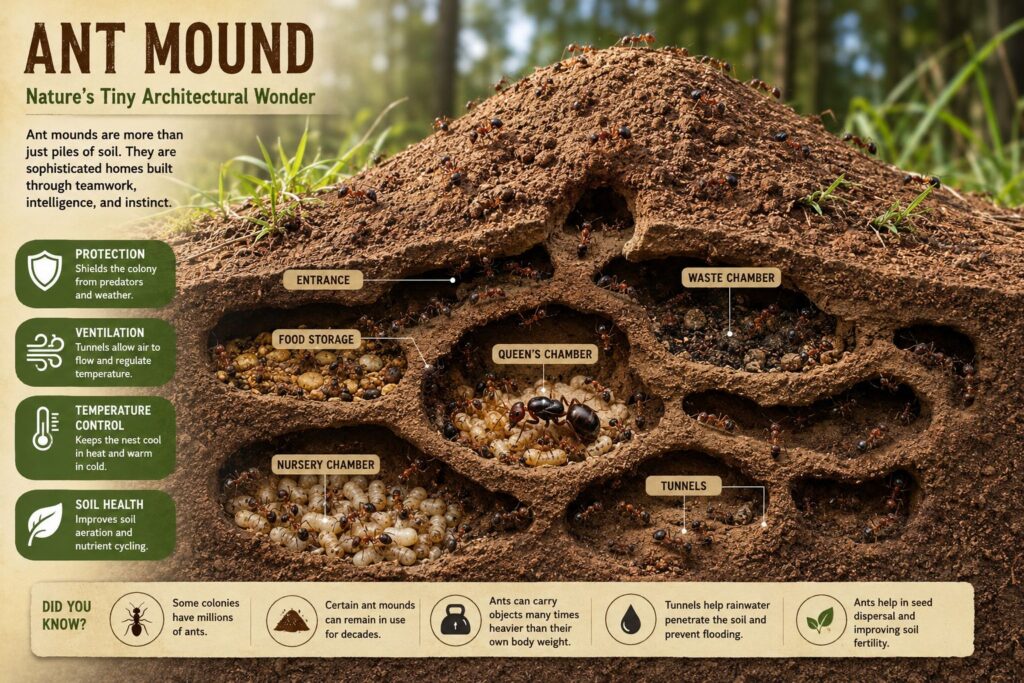
An ant mound is the visible part of an underground ant colony. It is typically made from soil, sand, leaves, pine needles, small stones, and other natural materials collected by worker ants. While the mound above the ground may appear small, the underground tunnel system often extends much deeper and wider than what is visible.
The primary purpose of an ant mound is to protect the colony from predators, flooding, and extreme temperatures. Inside the mound and beneath it lies a network of tunnels and chambers designed for different purposes, including nurseries for larvae, storage rooms for food, resting areas for workers, and chambers where the queen lays eggs.
Some ant species build modest mounds only a few centimeters high, while others construct enormous structures reaching over one meter in height. In tropical regions, certain ant colonies create massive nests that remain occupied for decades.
How Ants Build Their Mounds
Building an ants mound requires cooperation among thousands or even millions of worker ants. Every worker contributes by carrying tiny particles of soil or plant material in its mandibles. Although each ant follows simple instincts, together they create sophisticated structures.
The construction process generally follows these steps:
- Worker ants search for suitable building materials.
- Soil particles are loosened and carried to the nest entrance.
- Materials are deposited around the entrance, gradually forming the mound.
- Underground tunnels are expanded continuously.
- Damaged sections are repaired immediately after rain or disturbance.
- The colony keeps enlarging the mound as its population grows.
Construction is a continuous process. Ants constantly inspect, maintain, and improve their nest to ensure maximum safety and efficiency.
Structure of an Ants Mound
An ant mound is much more complex than it appears from the outside. Beneath the surface lies a carefully organized system of chambers connected by narrow tunnels.
| Part of the Mound | Purpose |
|---|---|
| Entrance | Allows ants to enter and leave the colony |
| Main tunnels | Connect different chambers throughout the nest |
| Nursery chambers | Protect eggs, larvae, and pupae |
| Queen’s chamber | Houses the queen ant safely |
| Food storage | Stores seeds, insects, and other food supplies |
| Waste chamber | Keeps garbage away from living areas |
| Ventilation shafts | Help circulate fresh air through the colony |
This organized layout ensures that every member of the colony has access to food, protection, and suitable living conditions.
Temperature Control Inside Ants Mound
One of the most remarkable features of ants mound is their natural climate control system. The mound acts like insulation, helping maintain stable temperatures throughout the year.
During cold weather, the soil retains heat generated by the colony and sunlight absorbed by the mound. During hot weather, deeper tunnels remain cool, allowing ants to escape excessive heat.
Many ant species also create ventilation tunnels that improve airflow. These natural ventilation systems remove excess moisture and carbon dioxide while supplying fresh oxygen to the colony.
Researchers have even studied ant mound ventilation to inspire energy-efficient building designs for humans.
Different Types of Ant Mounds
Ant species build different kinds of mounds depending on their environment.
Soil Mounds
These are the most common ant mounds. They are constructed mainly from soil and are frequently found in gardens, fields, and lawns.
Sand Mounds
Desert ants often build nests using loose sand. These mounds are designed to withstand high temperatures while allowing quick movement.
Leaf and Needle Mounds
Wood ants in forests build large mounds using pine needles, twigs, leaves, and small branches. These materials provide excellent insulation against cold weather.
Crater Mounds
Some ants create circular mounds with a central entrance surrounded by a raised ring of soil resembling a miniature volcano.
Underground Colonies
Certain species build very little above the ground. Most of their nest remains hidden beneath the surface.
Life Inside an Ants Mound
An ant colony functions much like a highly organized society where every ant has a specific role.
The queen’s primary responsibility is laying eggs. Worker ants gather food, clean the nest, care for larvae, defend the colony, and maintain tunnels. Soldier ants, found in some species, specialize in protecting the colony from predators and rival ants.
Young ants begin life as eggs before developing into larvae, pupae, and finally adults. Worker ants carefully care for developing young by feeding and cleaning them until they mature.
Communication within the colony relies mainly on chemical signals called pheromones. These invisible scent trails help ants locate food, identify nest mates, warn of danger, and coordinate construction activities.
Why Ants Mound Are Important for the Environment
Ant mounds provide many ecological benefits.
First, ants improve soil quality by digging tunnels that loosen compacted earth. This allows air and water to penetrate deeper into the ground, promoting healthier plant growth.
Second, ants help recycle organic matter by breaking down dead insects and plant material.
Third, many ants disperse seeds, helping various plant species spread to new locations.
Fourth, ant colonies serve as food sources for birds, reptiles, mammals, and other insects, supporting biodiversity.
Finally, the constant mixing of soil by ants redistributes nutrients and contributes to fertile ecosystems.
Predators of Ant Colonies
Despite their impressive defenses, ants face numerous predators.
Common predators include:
- Birds
- Lizards
- Frogs
- Spiders
- Beetles
- Anteaters
- Pangolins
- Other ant species
To defend themselves, ants use strong jaws, painful bites, stings, chemical sprays, and coordinated attacks. Thousands of workers may quickly gather to repel intruders.
How Ants Mound Survive Rain and Flooding
Heavy rain poses a significant challenge for ground-dwelling ants. Many species have evolved remarkable strategies to protect their colonies.
The sloped shape of the mound helps rainwater flow away from entrances.
Deep tunnels include drainage pathways that reduce flooding.
Some ants seal nest entrances during storms.
Certain tropical ants even form floating rafts using their own bodies until floodwaters recede.
These survival strategies allow colonies to recover rapidly after severe weather.
Amazing Facts About Ants Mound
Ant mounds contain many surprising features that highlight the extraordinary abilities of ants.
- Some colonies contain millions of ants.
- Certain ant mounds remain occupied for decades.
- Underground tunnels may extend several meters deep.
- Worker ants can carry objects many times heavier than their own body weight.
- Ants continuously repair damaged sections of their nests.
- Some forest ant mounds generate heat through decomposing plant material.
- Colonies carefully separate waste from living areas to reduce disease.
- Scientists study ant mounds to improve human architecture and ventilation systems.
Human Interaction with Ants Mound
People encounter ant mounds in gardens, farms, parks, and forest. While some species become household or agricultural pests, many are beneficial because they control harmful insects and improve soil health.
When encountering an ant mound in nature, it is best to observe it without disturbing the colony. Destroying a mound can eliminate thousands of beneficial insects that play important ecological roles.
Gardeners often encourage harmless native ants because they naturally aerate soil and contribute to healthier ecosystems.
Lessons Humans Can Learn from Ants
Ant mounds demonstrate that success often comes through cooperation rather than individual effort. Every ant contributes according to its abilities, allowing the colony to accomplish tasks impossible for a single insect.
Their efficient use of resources, constant maintenance, teamwork, and adaptive construction techniques offer valuable lessons for engineers, architects, business leaders, and environmental scientists.
Modern researchers continue to study ant colonies to develop smarter transportation systems, efficient ventilation, robotics, and self-organizing computer networks.
Conclusion
Ant mounds are extraordinary examples of natural engineering. Although they may appear to be simple piles of dirt, they are actually sophisticated homes designed to support complex societies of highly organized insects. Through cooperation, persistence, and remarkable building skills, ants create structures that regulate temperature, protect against predators, store food, and provide safe environments for future generations.
Beyond their architectural achievements, ant mounds contribute significantly to healthy ecosystems by improving soil, recycling nutrients, dispersing seeds, and supporting wildlife. Studying these remarkable structures not only deepens our understanding of nature but also inspires innovations in science, engineering, and sustainable design. The next time you notice an ant mound, remember that beneath your feet lies a bustling underground city built by some of the world’s smallest yet most industrious creatures.
FAQs
1. What is an ant mound?
An ant mound is the visible portion of an underground ant colony built from soil, sand, leaves, or other natural materials.
2. Why do ants build mounds?
Ants build mounds to protect their colony, regulate temperature, improve ventilation, store food, and provide safe spaces for the queen and developing young.
3. How deep can an ant mound be?
Some underground ant nests extend several meters below the surface, depending on the species and soil conditions.
4. Are ant mounds beneficial to the environment?
Yes. They improve soil aeration, recycle nutrients, disperse seeds, and support many other forms of wildlife.
5. Do all ants build mounds?
No. Some ants live inside wood, under rocks, within trees, or entirely underground without building noticeable surface mounds.
6. Can ant mounds survive heavy rain?
Many species build drainage systems, raised entrances, and waterproof tunnel designs that help protect the colony during storms.
7. How long can an ant colony live?
Depending on the species, some ant colonies survive for many years, while queens of certain species may live for decades.
8. Should people destroy ant mounds?
Unless the ants pose a significant safety or property concern, it is generally better to leave ant mounds undisturbed because ants provide valuable ecological benefits.