
Introduction
Attus volans is one of the most fascinating spiders ever described in scientific literature. Although its name may sound unfamiliar to many people, it has played an important role in the history of arachnology and the study of jumping spiders. The species belongs to the family Salticidae, a group renowned for exceptional vision, remarkable agility, and complex hunting behavior. Unlike web-building spiders that wait for prey, jumping spiders actively stalk and capture insects with precision.
Over the years, the classification of Attus volans has changed as scientists gained a deeper understanding of spider taxonomy. Early naturalists placed many jumping spiders under the genus Attus, but later research reassigned numerous species to more accurate genera. Today, the name Attus volans is primarily encountered in historical scientific references rather than modern taxonomic records. Even so, studying this species provides valuable insight into how biological classification evolves with new discoveries.
This article explores the history, taxonomy, physical characteristics, habitat, behavior, ecological importance, and scientific significance of Attus volans. It also examines why historical names remain important in biological research and how taxonomic revisions improve our understanding of biodiversity.
| Classification | Category |
|---|---|
| Kingdom | Animalia |
| Phylum | Arthropoda |
| Class | Arachnida |
| Order | Araneae |
| Family | Salticidae |
| Historical Genus | Attus |
| Historical Species | Attus volans |
What Is Attus volans?
Attus volans is a historical scientific name associated with a jumping spider belonging to the family Salticidae. Early arachnologists classified numerous jumping spiders within the genus Attus because detailed anatomical comparisons were limited at the time.
As scientific methods improved, researchers discovered significant differences among these spiders. Many species originally assigned to Attus were transferred to newly established genera that better reflected their evolutionary relationships. Consequently, the name Attus volans is now considered historical rather than commonly used in modern scientific classification.
Understanding historical names remains essential because they appear in older research papers, museum collections, and scientific catalogs.
Taxonomic Classification
The biological classification of Attus volans helps explain its place in the animal kingdom.
| Classification | Category |
| Kingdom | Animalia |
| Phylum | Arthropoda |
| Class | Arachnida |
| Order | Araneae |
| Family | Salticidae |
| Historical Genus | Attus |
| Historical Species | Attus volans |
History of the Scientific Name
The history of Attus volans reflects the evolution of biological science. During the eighteenth and nineteenth centuries, taxonomists relied mainly on visible body features. Since many jumping spiders shared similar appearances, they were grouped into the genus Attus.
Later studies involving reproductive organs, microscopic structures, behavior, and eventually DNA analysis revealed that these spiders represented many distinct evolutionary groups. As a result, scientists reorganized the family Salticidae and reassigned numerous species.
Although the original name may no longer be valid in current taxonomy, historical records remain valuable because they preserve information collected by early naturalists.
Physical Characteristics
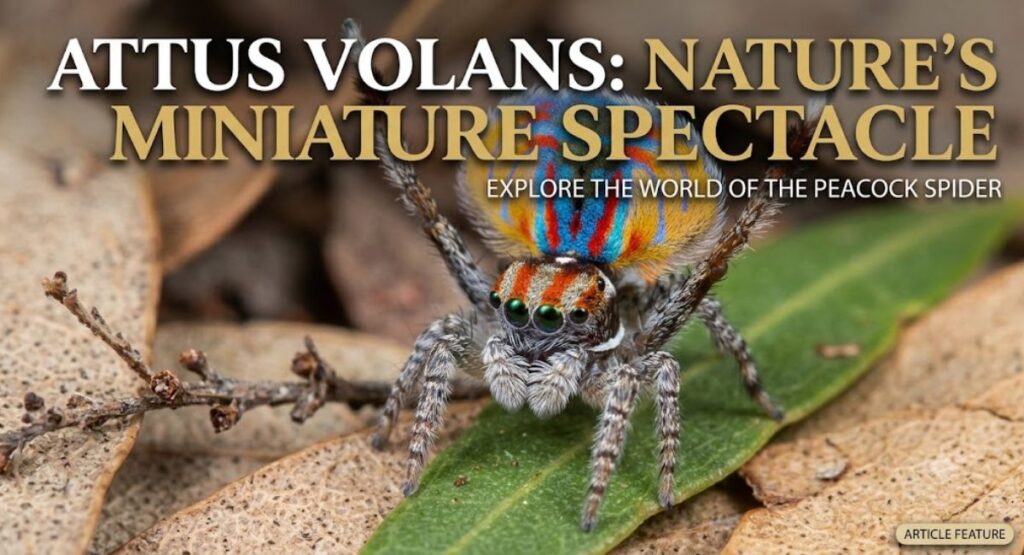
Like other jumping spiders, Attus volans would have displayed several distinctive characteristics associated with the Salticidae family.
These characteristics include:
- Compact body structure
- Short yet powerful legs
- Excellent jumping ability
- Large forward-facing eyes
- Sharp vision
- Hair-covered body
- Strong hunting instincts
- Active daytime behavior
The large anterior eyes provide exceptional depth perception, allowing jumping spiders to accurately judge distances before launching themselves toward prey.
Body Structure
The body of a jumping spider consists of two main sections.
The cephalothorax contains:
- Eyes
- Mouthparts
- Brain
- Legs
The abdomen contains:
- Digestive organs
- Reproductive organs
- Silk glands
Although jumping spiders produce silk, they rarely use it to build prey-catching webs. Instead, silk functions as a safety line during jumps and as material for protective shelters.
Vision and Hunting Skills
One of the most remarkable features of jumping spiders is their extraordinary eyesight.
Unlike many spider families that rely mainly on vibrations, jumping spiders depend heavily on visual information. They can detect movement from considerable distances, accurately identify prey, and carefully plan attacks.
Before jumping, the spider often pauses, studies its target, and adjusts its position. It then leaps with impressive precision, using silk as a backup safety line.
Habitat
Historically associated jumping spiders similar to Attus volans inhabit a variety of environments, including:
- Forests
- Meadows
- Grasslands
- Shrubs
- Gardens
- Agricultural fields
- Rocky landscapes
- Tree bark
- Leaf litter
Their adaptability enables them to survive across different climates and ecosystems.
Geographical Distribution
Jumping spiders are among the world’s most widespread spider families.
Species historically classified under Attus have been recorded from:
- Europe
- Asia
- Africa
- Australia
- North America
- South America
Their broad distribution reflects the adaptability and evolutionary success of the Salticidae family.
Diet
Attus volans, like other jumping spiders, is a carnivorous predator.
Its diet typically includes:
- Flies
- Mosquitoes
- Small beetles
- Ants
- Moths
- Aphids
- Tiny caterpillars
- Other small arthropods
Instead of trapping prey in webs, jumping spiders actively search for insects and ambush them using carefully timed jumps.
Behavior
Jumping spiders display surprisingly complex behavior compared with many other spiders.
Common behaviors include:
- Careful observation
- Active exploration
- Precise stalking
- Controlled jumping
- Territorial defense
- Courtship displays
- Nest construction
- Silk dragline production
Many species exhibit curiosity and may even observe nearby movement before deciding whether to flee or investigate.
Reproduction
The reproductive cycle follows several stages.
Male spiders typically perform elaborate courtship displays involving:
- Leg waving
- Body movements
- Vibrations
- Color displays
If the female accepts the male, mating occurs.
The female later produces silk egg sacs that protect developing offspring until they hatch.
Young spiderlings undergo multiple molts before reaching adulthood.
Role in the Ecosystem
Jumping spiders contribute significantly to ecosystem balance.
Their ecological roles include:
- Controlling insect populations
- Reducing pest numbers
- Supporting biodiversity
- Serving as prey for birds and reptiles
- Maintaining ecological balance
Because they consume numerous agricultural pests, they are considered beneficial in many farming systems.
Scientific Importance
Although the historical name Attus volans may no longer appear in modern taxonomic databases, it remains scientifically important.
Researchers studying:
- Taxonomic history
- Museum specimens
- Biodiversity records
- Evolution
- Historical literature
often encounter outdated species names. Understanding these historical classifications prevents confusion and improves the interpretation of earlier scientific publications.
Taxonomic Changes
Taxonomy constantly evolves as new evidence becomes available.
Scientists may revise classifications based on:
- DNA sequencing
- Microscopic anatomy
- Behavioral studies
- Geographic distribution
- Evolutionary relationships
These revisions improve the accuracy of biological classification and help researchers better understand species diversity.
Interesting Facts About Attus volans
Several fascinating facts make Attus volans an interesting subject.
- It belongs to the jumping spider family.
- Jumping spiders possess some of the best vision among spiders.
- They hunt without building prey-catching webs.
- Silk serves mainly as a safety line.
- They are active during daylight.
- Historical names remain important in taxonomy.
- Scientific classification changes as knowledge improves.
- Jumping spiders benefit agriculture by reducing pests.
Importance of Historical Scientific Names
Historical scientific names continue to play an important role in biology.
They help researchers:
- Trace scientific discoveries.
- Interpret older publications.
- Organize museum collections.
- Understand classification changes.
- Preserve scientific history.
- Compare historical and modern records.
Without historical taxonomy, many early scientific observations would become difficult to interpret.
Conservation
Although historical names such as Attus volans may not represent currently accepted species names, conserving jumping spiders as a whole remains important.
Conservation efforts focus on:
- Habitat protection
- Sustainable agriculture
- Reduced pesticide use
- Forest conservation
- Biodiversity preservation
Healthy ecosystems support stable jumping spider populations, which in turn help regulate insect communities.
Conclusion
Attus volans represents an interesting chapter in the history of spider taxonomy. While modern scientific research has reorganized many jumping spiders into different genera, historical names remain valuable for understanding the development of biological classification. As a member of the jumping spider family, this historically recognized species reflects the remarkable hunting abilities, excellent vision, and ecological importance shared by Salticidae.
Studying historical species names reminds us that science is continually evolving. New discoveries, improved technology, and genetic research allow scientists to refine classifications and deepen our understanding of Earth’s biodiversity. Whether encountered in historical literature or museum collections, Attus volans continues to contribute to the fascinating story of arachnological research.
FAQs
Q1. What is Attus volans?
Answer: Attus volans is a historical scientific name associated with a jumping spider that was originally placed in the genus Attus.
Q2. Is Attus volans still a valid scientific name?
Answer: The name is mainly considered historical because many species formerly classified under Attus have been reassigned to different genera through modern taxonomic research.
Q3. Which family does Attus volans belong to?
Answer: It belongs to the family Salticidae, commonly known as jumping spiders.
Q4. Do jumping spiders build webs to catch prey?
Answer: No. They actively hunt insects instead of using webs to capture prey.
Q5. Why is Attus volans important?
Answer: It is important because it represents the history of spider classification and helps scientists interpret older scientific literature and museum records.
Q6. What do jumping spiders eat?
Answer: They mainly feed on flies, mosquitoes, beetles, ants, aphids, moths, and other small insects.
Q7. Where are jumping spiders commonly found?
Answer: They occur in forests, grasslands, gardens, agricultural fields, shrubs, and many other habitats across the world.
Q8. Why do scientific names change over time?
Answer: Scientific names change when researchers discover new evidence about a species’ anatomy, genetics, behavior, or evolutionary relationships, leading to more accurate classification.