
Introduction
In the late 19th century, the city of Belém, nestled in the heart of the Brazilian Amazon, underwent a dramatic and dizzying transformation. The global industrial revolution had created an insatiable demand for rubber, and the Amazon basin was the primary source of this valuable commodity. Overnight, local landowners, traders, and rubber barons found themselves possessing fortunes that rivaled the old aristocracies of Europe.
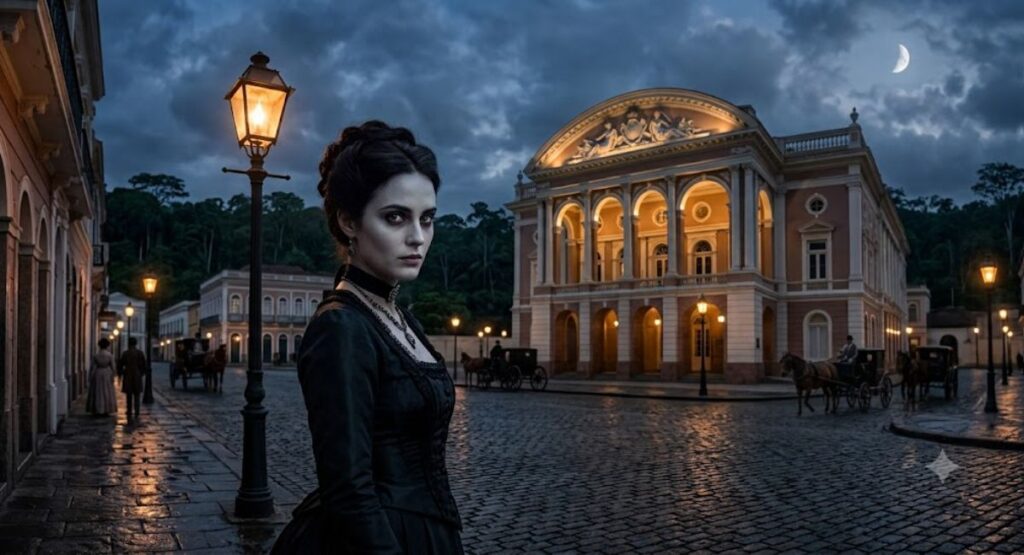
Seeking to distance themselves from the raw, untamed wilderness that surrounded them, the elite of Belém set out to recreate Europe in the middle of the jungle. They paved the streets with imported stones, constructed opulent mansions, and erected the magnificent Theatro da Paz (Theater of Peace)—a neoclassical masterpiece designed to rival the grandest opera houses of Paris and Milan. Wealthy barons thought nothing of sending their clothes to Europe to be laundered, and they routinely paid astronomical fees to bring the finest continental artists, musicians, and performers across the Atlantic to entertain them.
It was during this era of intoxicating wealth and cultural obsession around the early 1890s, that a woman arrived who would change the city’s folklore forever. Her name was Camille Monfort.
An opera singer of exceptional talent, Camille possessed a dramatic soprano voice that could effortlessly fill the cavernous halls of the Theatro da Paz. She was stunningly beautiful, with pale skin that contrasted sharply against the sun-baked complexions of the local population, piercing dark eyes, and raven hair. Yet, from the moment she stepped off the ship from France, it was clear that Camille was not like the other visiting artists. While others sought the adulation of high society and integrated into the daily routines of the elite, Camille remained aloof, solitary, and shrouded in an air of impenetrable mystery.
Within months of her arrival, the initial admiration of the local aristocracy began to curdle into something far more sinister. Her eccentric behaviors, independent lifestyle, and refusal to conform to Victorian social expectations sparked a wildfire of gossip. What began as whispers in polite drawing rooms eventually evolved into a terrifying, full-fledged urban legend that persists to this day: the tale of the “Vampire of Amazonia.”
The Making of an Anomaly
To understand why Belém’s high society turned so aggressively against Camille Monfort, one must understand the rigid social constraints of the Victorian era, particularly regarding women. The wives and daughters of the rubber barons were expected to be models of modesty, domesticity, and submission. They appeared in public escorted, dressed according to strict etiquette, and participated only in approved social functions.
Camille shattered every single one of these unspoken laws.
The Nocturnal Recluse
The most glaring abnormality was her complete absence during daylight hours. In a city where social life for the wealthy involved morning strolls, afternoon teas, and daytime carriage rides, Camille was a ghost. Her rented mansion, a sprawling, gothic-style estate surrounded by dense, overgrown mango trees, remained tightly shuttered from dawn until dusk. Heavy velvet curtains blocked out every sliver of the equatorial sun.
Servants whispered to neighbors that Mademoiselle Monfort slept through the day in a room kept entirely dark. She would only stir as the sun began to dip below the horizon, bathing the Amazon river in blood-red hues.
The Midnight Wanderer
When she did venture out, it was always late at night, long after the respectable citizens of Belém had retired to their beds. Dressed in elaborate, flowing silk and lace gowns—invariably in shades of midnight black or deep crimson—Camille would walk the gas-lit streets completely unescorted.
Her favorite destination was the banks of the Guajará River. Local fishermen and dockworkers, pulling in their late-night catches, reported seeing her pale figure standing motionless by the water’s edge, staring out into the dark, churning currents of the river as if listening to voices from the deep jungle. For a lone woman to walk the city streets at midnight without a male guardian was scandalous; for her to do so with such eerie calmness was terrifying to a superstitious public.
The Rain Dancer
Perhaps the most scandalous rumor involved her behavior during the sudden, violent downpours that characterize life in the Amazon. Belém is famous for its heavy afternoon rains. According to local lore, on several occasions when the clouds burst over the city, Camille was seen stepping out into the torrential rain, shedding her heavy outer garments, and dancing half-naked through the muddy, deserted streets.
To the deeply religious and conservative population of Belém, this was not mere eccentricity—it was evidence of madness, paganism, or worse, demonic possession.
The Siren of Theatro da Paz
While her private life was a source of scandal, it was her public performances at the Theatro da Paz that truly cemented her supernatural reputation. When Camille sang, she did not merely perform; she seemed to exert a hypnotic control over her audience.
| Observation | Popular Interpretation |
| Audience members swooned or fainted | Vampiric energy draining the room |
| Pale, bloodless complexion | A strict diet of human blood |
| Hypnotic, intense stage presence | Mesmerism, dark magic, and witchcraft |
| Shuttered, dark mansion | Total inability to face direct sunlight |
The Transfixed Audience
The theater would fill to maximum capacity whenever Camille was billed to perform. The rubber barons and their families sat in gold-leafed boxes, completely transfixed by her presence. Her voice possessed an ethereal, almost haunting quality that seemed to vibrate through the very structure of the building.
However, accounts from the time noted a bizarre phenomenon: during her most intense arias, audience members—particularly young, affluent men—would frequently experience sudden bouts of dizziness, vertigo, and fainting spells. While modern medical knowledge would attribute this to the stifling, humid heat of an un-airconditioned theater packed with hundreds of people dressed in heavy European formal wear, the citizens of 19th-century Belém had a far more gothic explanation.
They whispered that Camille was a psychic vampire, using her beautiful voice as a tool of mesmerism to lower the defenses of her listeners, allowing her to feed on their vital life force and spiritual energy while they sat paralyzed in their seats.
The Pale Siren
Her physical appearance on stage only fueled these theories. Even under the warm glow of the theater’s gas lamps, her skin appeared translucent, almost blue-white, completely devoid of the flush of life. Her lips, by contrast, were always painted a shocking, vivid red.
Young men who were fortunate enough to be granted an audience with her in her dressing room reported that her touch was as cold as ice. They claimed that after speaking with her, they felt strangely drained, lethargic, and lightheaded for days, as if a portion of their very vitality had been left behind in her presence.
The Cult of the Dead
As the years progressed, the rumors surrounding Camille shifted from scandalous lifestyle choices to outright witchcraft and occultism. The late 19th century saw a massive surge of interest in Spiritualism, séances, and the occult across Europe, and it was widely believed that Camille had brought these dark arts with her from Paris.
The Midnight Séances
Local authorities and religious figures grew increasingly alarmed by reports of what was happening behind the closed doors of Camille’s estate. Neighbors claimed to see strange, cloaked figures arriving at her home long after midnight. From the interior of the mansion, muffled sounds of chanting, rhythmic drumming, and strange, melodic wailing would drift through the humid night air.
The rumor spread that Camille was a powerful medium capable of piercing the veil between the living and the dead. It was said that the wealthy rubber barons, devastated by the frequent loss of family members to tropical diseases, would secretly pay her vast fortunes to commune with the spirits of their deceased loved ones.
The Pact with the Jungle
However, the local indigenous and Afro-Brazilian populations had their own interpretation. Belém was a melting pot of European culture and deeply rooted local spiritual traditions, including shamanism and early forms of Umbanda and Candomblé.
Many of the local working-class citizens believed that Camille had made a pact with the ancient, dark spirits of the Amazon rainforest. They believed her nocturnal wanderings by the river were not for solitude, but to offer sacrifices to the water deities and entities of the jungle in exchange for her mesmerizing beauty, her flawless voice, and her apparent agelessness.
The Epidemic and the Ghost of Soledade
In late 1896, the golden age of Belém was struck by a catastrophic blow. A devastating outbreak of yellow fever and cholera tore through the city. The crowded, humid conditions and lack of modern sanitation turned the tropical paradise into a literal graveyard. The disease spared no one; wealthy barons and impoverished laborers alike succumbed to the sudden, agonizing illness.
Among the reported casualties of this horrific epidemic was Camille Monfort.
The Secret Burial
Because the diseases were highly contagious, the city authorities ordered that the bodies of the victims be buried immediately, often in hasty, nighttime ceremonies with minimal witnesses, to prevent further spread of the infection. Camille was reportedly laid to rest in the Cemitério da Soledade (Solitude Cemetery), a beautiful but hauntingly dense graveyard filled with grand, moss-covered European-style tombs and weeping marble angels.
The news of her sudden death sent shockwaves through the city, but the grief was short-lived, quickly replaced by a renewed wave of terror.
The Apparition at the Gate
Within days of her alleged burial, the cemetery guard, an elderly man accustomed to the quiet solemnity of the graveyard, fled his post in a state of absolute terror. He swore to the local police that he had seen a woman matching Camille’s exact description stepping out from the shadows of the tombs. She was dressed in her signature black silk gown, her skin glowing with an unnatural, luminescent pallor under the moonlight. According to his account, she floated silently past him, her dark eyes locking onto his before she vanished into the mist near the cemetery’s main iron gates.
As the story of the guard’s encounter spread, several brave citizens went to inspect Camille’s final resting place. To their horror, they discovered that the stone slab sealing her tomb had been cracked and shifted. Whispers immediately rippled through the city: The tomb is empty. Camille Monfort was never truly human, and the grave could not hold her.
For decades following her death, sightings of the “Vampire of Soledade” became a regular fixture of Belém’s folklore. Night shift workers, carriage drivers, and later, automobile drivers, claimed to have seen a strikingly beautiful, pale woman in a Victorian gown walking the perimeter of the cemetery late at night. Whenever anyone approached her to offer assistance, she would turn her head, smile a blood-red smile, and dissolve into the humid night air.
Historical Analysis – Disease, Xenophobia, and Fiction
To the modern historian and folklorist, the legend of Camille Monfort is a goldmine of cultural insight. It represents a perfect storm of 19th-century anxieties, medical ignorance, and the natural human tendency to create myths to explain the inexplicable.
The Reality of Porphyria and Anemia
If we assume that Camille Monfort was indeed a real, living historical figure who exhibited these behaviors, modern medicine offers several highly plausible explanations for her lifestyle that have absolutely nothing to do with the supernatural.
Medical Conditions Misidentified as Vampirism
- Porphyria: This is a group of rare genetic blood disorders that interfere with the body’s production of heme (a component of hemoglobin). Certain types of porphyria cause extreme sensitivity to sunlight. Exposure to UV rays can cause severe skin blistering, burns, and scarring. Individuals with this condition must live a strictly nocturnal lifestyle to avoid agony, resulting in an incredibly pale, translucent complexion. In the 19th century, before this disease was understood, sufferers were frequently accused of being vampires.
- Severe Anemia: A profound lack of healthy red blood cells or hemoglobin can cause extreme lethargy, an icy-cold touch, and a ghostly, bloodless skin tone. It also causes frequent fainting spells—which might explain why Camille appeared fragile or required long periods of rest.
- Catalepsy: During the cholera and yellow fever epidemics, medical infrastructure collapsed under the weight of the dying. Catalepsy, a nervous condition causing a trance-like state where a person’s heart rate and breathing slow down to almost imperceptible levels, frequently led to people being mistakenly pronounced dead and buried alive. If Camille suffered from a medical condition that caused cataleptic fits, she may have mistakenly been sent to the graveyard, only to wake up and escape her tomb, sparking the “empty grave” rumors.
Xenophobia and the Punishment of Independence
It is also crucial to view the legend through the lens of social politics. Camille was a foreign woman living alone in a deeply patriarchal society. She was wealthy, highly educated, sexually liberated by local standards, and refused to seek the approval or protection of men.
In the 19th century, a woman who possessed that much autonomy was viewed as a direct threat to the established social order. Demonizing her—labeling her a witch, a madwoman, or a vampire—was a highly effective way for society to neutralize her influence, punish her independence, and warn other women of the consequences of violating social norms. Her pale skin, French accent, and artistic intensity made her the perfect canvas onto which the community could project their fears of the “foreign outsider” corrupting their traditional values.
The Modern Twist – The Power of Literary Myth
For over a century, the story of Camille Monfort was passed down through generations in Northern Brazil as a genuine piece of historical folklore. However, in the digital age, the story underwent a massive global resurgence. Articles, TikTok videos, and horror blogs across the internet began sharing her photograph, recounting her dark deeds, and calling her the “true vampire of history.”
This modern internet virality led researchers and journalists to dig deep into the municipal archives of Belém, the historical records of the Theatro da Paz, and the burial registries of the Cemitério da Soledade to find the definitive historical truth of Camille Monfort.
What they discovered was a stunning testament to the power of literature.
The Creation of Bosco Chancen
The historical reality is that Camille Monfort never actually existed. She is not a historical figure whose life was distorted by rumor; rather, she is a completely fictional character created by the contemporary Brazilian author Bosco Chancen.
Chancen, a writer deeply enamored with the history and gothic architecture of his hometown of Belém, wrote a historical fiction novel titled After the Afternoon Rain. Seeking to capture the decadent, ghostly atmosphere of the rubber boom era, he invented the character of Camille Monfort, meticulously weaving her story into real historical settings like the Theatro da Paz and the yellow fever epidemic of 1896.
To promote his literary work and create an immersive experience for his readers, Chancen utilized early internet forums, blogs, and social media to share snippets of the story as if they were real historical accounts. He paired the text with beautifully edited, sepia-toned vintage photographs of 19th-century women who resembled his vision of Camille.
The Myth Becomes Reality
The experiment succeeded far beyond the author’s wildest dreams. The story was so perfectly constructed, so rich in historical detail, and so resonant with existing gothic tropes that the internet swallowed it whole. Within a few years, the line between Chancen’s fiction and genuine history completely dissolved. People forgot about the book and began treating Camille Monfort as a real historical figure, alongside famous historical vampires like Vlad the Impaler or Countess Elizabeth Báthory.
Today, the legend has come full circle. Tour guides in Belém occasionally report that tourists visit the Cemitério da Soledade specifically asking to see the final resting place of the French va
FAQs
Q1: Was Camille Monfort a real person?
No. Historical research has proven that Camille Monfort is a fictional character. She was created by the Brazilian author Bosco Chancen for his historical gothic novel, After the Afternoon Rain.
Q2: Why did people think she was a vampire?
According to the urban legend, her strictly nocturnal habits, extremely pale skin, hypnotic operatic performances that caused people to faint, midnight walks by the river, and the rumor of her empty tomb all contributed to the local belief that she was a vampire.
Q3: Where is she supposedly buried?
In the legend, she was buried in the historic Cemitério da Soledade (Solitude Cemetery) in Belém, Brazil, after supposedly dying of yellow fever or cholera in 1896.
Q4: What real-life disease explains the vampire symptoms associated with her?
If a real person had displayed these traits, they would likely be attributed to Porphyria (a genetic blood disorder causing extreme sensitivity to sunlight and pale skin) or Severe Anemia.
Q5: What was the Theatro da Paz?
The Theatro da Paz is a very real, historic opera house in Belém, Brazil, built in 1878 during the rubber boom. It serves as the primary setting for Camille’s legendary performances in the story.